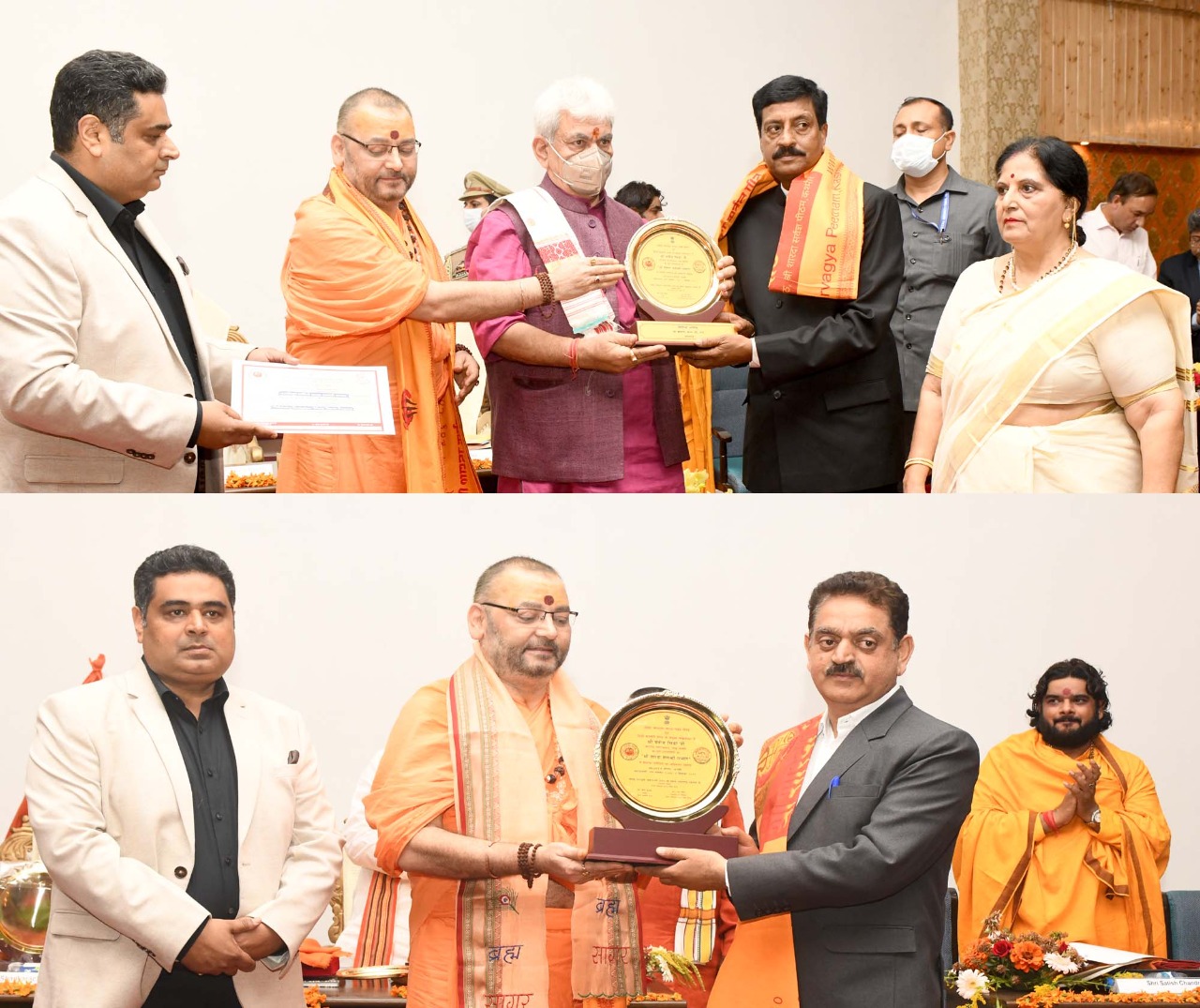
An amazingly enlightening and proud events marked the culmination of an International Seminar from September 2 to 4.
The culmination of the eleventh felicitation ceremony and international seminar on Adi Guru Shankaracharya, Sufis and saints of Kashmir, their contribution and influence in regional spiritual literature and also historical and cultural significance of Sarvagya Sharda Peeth was held at SKUAST Kashmir.
The program started with the lightening of lamp by Lt Governor Manoj Sinha and Shankaracharya Swami Amritanand Devtirthji Maharaj.
At the auspicious event Shankaracharya Swami Amritanand Devtirthji Maharaj did Mangalaarti and also chanted mantras for propitiation of Sharda Devi.
Prem Lataji was the stage secretary, who with her melodious voice and oratory skills welcomed lieutenant Gov Manoj Sinha ji, Shankaracharya Swami Amritananda Devtirthji Maharaj and all the other Dignitaries present on the stage.

Pertinently Swami Keshwanandji arrived in Kashmir all the way from Holland to attend the international seminar.
Also were present other greats from across the country including Shri Raj Walia, Shri Anuj Chopra, Shri Sanjay Maini, Shri Rahul Gupta, Shri Rohit Singhal, Shri Acharya Madan, Shri Nishant Jindal, Shri Virender Bangru and Shri Gopal Krishan Nayyar. On the occasion a number of awards were distributed and daily newspaper Tameel-i-Irshad was awarded for fair journalism promoting peace and brotherhood apart from highlighting steps being taken for over overall prosperity of J&K and country.
Senior journalist Raja Mohidin received the award for Tameel-i-Irshad.
Earlier, Lt Gov in his address said that Kashmir has been a land of spirituality and Science. He said words of encouragement for students, researchers and scholars to take the tradition of Kashmir forward. He also highlighted the historical significance of SharadaPeetham and how Lord Brahma entrusted MaaSharada with the elixir (Amrit) for (procured from the churning of the ocean) safe keeping.
Shankaryacharyaji also enlightened the dignitaries present at the event about the history and shared the legend of samudramanthan related to SharadaPeeth and also highlighted its ethical importance. He also mentioned the aerial distance of Sharadapeeth from Gurez, the place that he recently visited. He also proclaimed that the day is not very far when the devotees of MaaSharada will be able to pay their obeisance at the shrine.

After Swami Amritanandji’s addressed, dignitaries from Kashi Vidyut Parishad Ramnarayanji, Vinay Pandey ji and Dinesh k Garg ji, facilitated Shankaracharya Swami Amritanandaji. Earlier in 2003, Kashi Vidut Parishad had anointed Swami Amritanandaji with the designation of Shankaracharya of Sharadapeeth in Kashi.
It was Kashi Vidyut Parishad’s heartiest wish to facilitate Shankaracharya Swami Amritanandji in Kashmir, since It is believed that no-one’s pilgrimage to Kashi is spiritually complete without paying obeisance at Sharada Shakti peeth in Kashmir. Therefore, today they presented Shankaracharya Swami AmritanandaDevtirthji with pramanpatra in presence of Lt GovManoj Sinha ji here at Kashmir after 19 years in 2022.
Several books were released and authors were also honoured by Lt Governor Manoj Sinha ji and Swami Amritanandaji.
“Jurisprudence of Experiential Learning Law: challenges and perspectives from the Precepts of National Educational Policy 2022”, by Prof K. L. Bhatiya.
“AntermannkaSwar”, by Ragini Prasad. “IshqSamundar to Nahi”, by Jaspreet Kaur Falak. “ZindagikoTalashateKinner”, by BeenaBudki. “Kashmir evamSharadapeethkaItahasikevamSanskritikmahatav; ek drishti”, by PremLata.
The vote of thanks was delivered by Dr. Raja Langer, Director SarvagyaShardaPeeth. He detailed about each and every individual who has been instrumental in the successful completion of the conference and award ceremony.
Dr. BeenaBudkiji co-organizer from Hindi Kashmiri sangam, also offered her gratitude towards Lt GovManoj Sinha ji, Swami Amritanandaji and others present at the event.
Sh. Om Prakash Pandey ji shared his insights and knowledge about grandeur and vastness of Santan Dharma. In his speech he spoke on the scientific aspect of various rituals performed in Sanatan Dharma and also recited and elaborated some sutras from Shiv Sutra (an ancient text of Kashmir Shaivism).
At the event were present other prominent figures like Acharya RaghunathDassVedantiji, VishwamurthyShastriji and Vishwamurthyshastriji from Kashi VidyutParishad, they Facilitated Shankaracharya on behalf of Kashi Vidyutparishad.

The Guests of honor felicitated by Lt Gov. Manoj Sinha were: Om Prakash Pandey ji, Space Scientist and famous custodian of Sanatan Sanskriti Sanrakshan.
Kashi VidyutParishadParivaar. Sri Ram Narayan Dwivediji, mahamantri Kashi VidyutParishad.
Padambhushan prof VishavmurtiShastriji, President Kashi VidyutParishad, Jammu.
SmtVasudha Mishra IAS, New Delhi, Administrative dept. Sh. Satish Chandra ji, chairman LokSevaAayog, J&K. Sh. DrakshaAndrabiji, Chairman Waqf Board, J&K. Sh. Raja Babu Singh ji IPS, BSF, Kashmir. Sh. KarunaSagarji, IPS, Tamilnadu. Sh. Shiv Singh SarangDeolji, Vice Chancellor University, Janardan Ray Nagar. Prof. J P Sharma ji, Vice Chancellor SAUKAST, Jammu. Prof. Nazir A Ganai, Vice Chancellor, SAUKAST, Kasmir. Dr. Ratnakar Sharma, HoD Surgery GMC, Jammu Prof. Akbar Masood, Vice Chancellor, BGSBU, Rajouri.
Prof. Ramesh Pandey, Ex VC, LBS Sanskrit University, New Delhi. Swami Keshvanand, Founder & Director international AdiShankara research and wareness foundation, Netherlands. Dr. Akhilesh Sharma, Ayurveda, America.
Dr. Ruby BakshiKhurdi, Switzerland.
Meanwhile Roman Nissar, Dr. Kaiser M Malik, Dr. Shahid A Hakeem, Dr. Raies A Bhat
District Agro Meteorological Unit, Krishi Vigyan Kendra Kupwara, SKUAST-K
Food production has seen various advancements globally in developing countries, such as India. The production of food within India was insufficient with effect from 1947 to 1960 as there was a growing population, during which a famine was also anticipated. But with the advent of Green Revolution, India transformed to a food grain surplus country from a deficit one. The green revolution led to high productivity of crops through adapted measures, such as increased area under farming, double-cropping, adoption of HYV of seeds, increased use of inorganic fertilizers and pesticides, improved irrigation facilities, and improved farm implements and crop protection and modifications in farm equipment. There was a significant increase in the usage of pesticides during this period, and India became one of the largest producers of pesticides in the whole of Asia, which in turn resulted in significant economic gains. There was a repetition of the crop cycle for increased crop production and reduced crop failure, which depleted the soil’s nutrients. Similarly, as there is no return of crop residues and organic matter to the soil, intensive cropping systems resulted in the loss of soil organic matter. Moreover, to meet the needs of these new kinds of seeds, farmers increased the use of chemical fertilizers which also deteriorated the soil quality. The application of pesticides and fertilizers led to an increase in the level of heavy metals, especially Cd (cadmium), Pb (lead), and As (arsenic), in the soil. Weedicides and herbicides also harmed the environment. The soil pH increased after the green revolution due to the usage of these alkaline chemicals. The practice of monoculture (only wheat–rice cultivation) also had a deleterious effect on many soil properties, which includes migration of silt from the surface to subsurface layers and a decrease in organic carbon content. Toxic chemicals in the soil destroyed beneficial pathogens, which are essential for maintaining soil fertility. In addition, the usage of tractors and mechanization damaged the physicochemical properties of the soil, which affected the biological activities in the soil. All these practices deteriorated the soil health and ultimately our environment. To restore our environment particularly our soil we need to shift our focus on other options of farming like organic farming, natural farming etc.
Organic farming /ecological farming/ biological farming is a holistic approach which relies mainly on organic sources of fertilizers viz., compost manure, green manure, bone meal, biofertilizers and agronomic practices like crop rotation and companion planting. Besides, biological pest control, ecological engineering, mixed cropping and the fostering of insect predators is also emphasized. Prohibition of synthetic substances and use of only naturally occurring substances is regulated by organic standards. These organic agricultural methods are internationally regulated and legally enforced by many nations, based in large part on the standards set by the International Federation of Organic Agriculture Movements (IFOAM), an international umbrella organization for organic farming organizations established in 1972. Organic agriculture is developing rapidly and today at least 170 countries produce organic food commercially. India produces around 27,132,966 MT of certified organic products including all types of food viz., Basmati rice, pulses, honey, tea, spices, coffee, oil seeds, fruits, processed food, cereals, herbal medicines and their value added products. This production is not just limited to the edible sector; it includes organic cotton fiber, garments, cosmetics, functional food products, body care products, etc. These organic products have a huge demand and can be marketed internationally to EU, US, Australia, Canada, Japan, Switzerland, South Africa and the Middle East. Currently, around 12 states -Chhattisgarh, Tamil Nadu, Uttar Pradesh, Telangana, Sikkim, Bihar, Madhya Pradesh, Gujarat, Karnataka, Odisha, Rajasthan, and Uttarakhand – have state organic certification agencies accredited by APEDA (Agricultural and Processed Food Products Export Development Authority). About 50,000 hectares of land in Jammu and Kashmir is used for organic farming, and it has an organic certified area of 22,316 hectares. The Central Government had given priority to Jammu and Kashmir in promoting organic agriculture. Till now, an area of 1180 hectares has been identified for organic farming and more than 3000 farmers in the state have been given the training in organic farming.
Organic farming advocates sustainability, self-sufficiency, autonomy, health, food security, food safety and also promotes crop diversity in terms of polyculture. Due to inhibition of herbicides and pesticides, a boost in biodiversity fitness and population density is observed. Organic farming not only builds healthy soil but also helps combat erosion, supports water conservation and water health. Food safety is also ameliorated on account of lower nitrogen application, minimal use of pesticides and chemical fertilizers which in turn reduces the incidences of cancer, coronary heart disease and stroke. Organic food is healthier, tastier, authentic, natural, free from pesticides, antibiotics and Genetically Modified Organisms, low in nitrate content, safe and certified over non-organic food. Organic farming has the potential to support biodiversity conservation by augmenting the number as well as the diversity of the wild species on farms, maintaining soil health and thus soil flora and fauna, reducing the risk of water pollution and being energy efficient.
The majority of small scale farmers are using poor agroecological practices that degrade the environment. There is a need to provide knowledge and service to farmers, who have inadequate knowledge of ecological organic farming techniques, market skills of natural/organic products, and sustainable livelihoods. Organic farming business has a huge potential here owing to its benefit to health, and environment, Improved agricultural cycle, Reduced imports of pesticides and other foreign fertilizers and Increased employment generation. Before using the organic label, farmers must receive certification that the product complies with applicable standards following third-party inspections of their operations. Soil health is the main foundation of organic systems. Fertile soil will provide essential plant nutrients while supporting an active biotic community that helps the soil resists environmental degradation.

The Government of India provides assistance for promoting organic farming across the country though different schemes like Paramparagat Krishi Vikas Yojana (PKVY), Mission Organic Value Chain Development for North Eastern Region (MOVCDNER), Capital Investment Subsidy Scheme (CISS) under Soil Health Management Scheme, National Mission on Oilseeds and Oil Palm (NMOOP) and National Food Security Mission (NFSM). SKUAST Kashmir is also playing a pivotal role in popularization / adoption of organic farming among farming community by imparting and dessiminating trainings and methodologies in every part of Kashmir through its various outlets like KVKs, Faculties. In this context, vermi beds, biofertilizers and other organic sources are also provided to farmers free of cost at various KVKs. KVK Kupwara is also playing a pivotal role in promoting organic farming and about 300 NADP compost pits, 10 woven vermi beds, 2 low cost vermi compost pits and 200 bottles of organic waste decomposers were distributed among farmers till date. Besides, KVK Kupwara has also laid OFT/FLDs on use of bio-inputs to popularize organic farming. Many farmers of district Kupwara are producing organic products but due to lack of marketing they aren’t getting due returns on time. KVK Kupwara helps in creating consumer level awareness among the people and brigdes the gap.
Despite all the benefits of organic farming on biodiversity and environmental protection, it also comes with some limitations such as significant costs at the beginning, pest issues, expensive products for the poor families, strict regulatory standards to be met, high certification costs, time- consuming, need of expert knowledge, high variance in yield and may not be suitable for growing on a large scale. Organic farming should not be seen as an isolated technology but as a systematic approach that embodies principles of human ecology and sustainable development.